For cabinet makers, distributors, and project teams, understanding that relationship helps prevent callbacks, sticking doors, visible gaps, and costly replacements. A fictional supplier, Northline Cabinetry, illustrates the point: by matching materials to the destination climate and checking how panels are assembled, its buyers can assess warping risk before placing a wholesale order.
Moisture Content and Cabinet Door Warping
Wood is hygroscopic: it exchanges moisture with the surrounding air until it approaches equilibrium moisture content (EMC). As humidity rises, wood takes on moisture and expands; as the air dries, it loses moisture and shrinks. These seasonal shifts can gradually change a door’s dimensions, even when its finish looks intact.
For interior projects, wood is commonly prepared near 6–8% moisture content, but the appropriate target depends on the climate where the doors will be installed and used. A door manufactured in a humid region and fitted into a dry, heated home may shrink; one moved from a dry warehouse into a damp building may swell. Finishes slow moisture exchange, but they do not stop it.
Northline therefore asks where an order will be installed before approving a specification. A coastal renovation, a heated apartment, and a seasonal residence can expose identical doors to very different conditions. The useful measure is not simply whether the wood is “dry,” but whether its moisture level suits its intended environment.

Panel Construction and Dimensional Movement
Material selection matters, but the way a door is assembled determines whether moisture-driven dimensional movement causes trouble. A broad, uninterrupted wood panel can expand across its grain as humidity changes. If rigidly trapped, it may bow, split, or push against the surrounding frame.
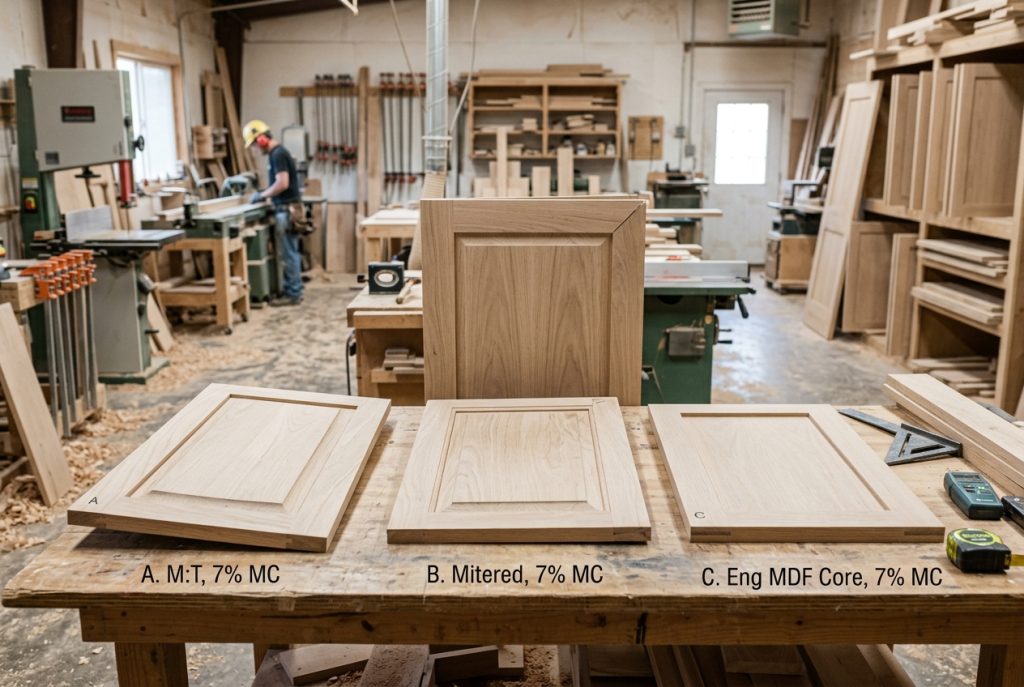
Traditional frame-and-panel construction addresses this movement by allowing the center panel to float within grooves in the frame. The rails and stiles hold the door together, while the panel can expand and contract without forcing the entire assembly out of shape. This design does not eliminate wood movement; it gives that movement room to happen safely.
Flat, wide doors deserve particular attention because their size makes changes more visible. Northline compares panel width, frame design, and joinery before approving a large order. A well-designed floating panel can stay serviceable through seasonal shifts where a tightly constrained slab might distort.
Cabinet Door Materials and Wood Stability
Different cabinet door materials respond differently to changes in moisture. Solid wood panels offer natural grain and can be repaired or refinished, but their performance depends on species, cut, drying, and construction. Engineered wood products, including stable composite cores, are often less prone to movement across a broad surface, although their edges and finishes still need protection.
With solid wood, wood grain orientation affects how a panel changes shape. Wood moves more across the grain than along it, so the board’s cut and the arrangement of pieces influence the likelihood of cupping or twisting. Quarter-sawn stock is often more dimensionally stable than flat-sawn stock, though the full assembly and service climate remain decisive.
No material is automatically warp-proof. A stable core can be undermined by an unbalanced finish or poor storage, while a solid-wood door can perform well when properly dried and allowed to move. The following comparison helps buyers frame the discussion with manufacturers:
| Door type | Movement considerations | Specification focus |
|---|---|---|
| Solid wood frame and panel | Panel expands and contracts across the grain; a floating fit accommodates movement. | Moisture level, species, grain orientation, and panel clearance. |
| Solid wood slab | A wide, continuous board can cup or twist as moisture changes. | Board selection, width, balanced coating, and destination climate. |
| Engineered wood panel | Core is generally more uniform, while exposed edges may be moisture-sensitive. | Core type, edge sealing, surface finish, and storage conditions. |
That comparison is a starting point, not a substitute for reviewing the actual door specification. Material stability comes from the combination of core, construction, finish, and handling—not from a label alone.
Wholesale Specifications and Installation Conditions
For wholesale buyers, consistent checks across production and delivery reduce surprises. A moisture meter can reveal differences between boards or panels that look equally dry on the surface. Pin-type meters measure resistance between probes, while pinless meters scan without leaving small holes; readings should be taken at multiple points and interpreted for the material being tested.
Before approving an order, Northline reviews a short set of practical details with its supplier. These questions connect factory conditions to the demands of the final project:
- Moisture target: Is the door’s moisture content appropriate for the expected indoor environment?
- Construction: Can the panel move within the frame, or is it fixed in a way that restrains cross-grain expansion?
- Material and grain: What core, wood species, and grain orientation are used?
- Finishing: Are all faces and edges treated consistently to help moderate moisture exchange?
- Storage and acclimation: Will doors be kept dry and allowed to adjust to the installation space before fitting?
The lasting lesson is that cabinet door warping is best prevented through a chain of compatible choices: suitable moisture content, movement-aware panel construction, stable materials, balanced finishing, careful storage, and installation in an appropriate environment. When these factors are specified together, wholesale doors are far more likely to remain aligned through changing seasons.